
Calendar days, trade dates
Count calendar days. Use the trade date on your confirmation, never the settlement date.
26 U.S.C. §1091 · Pub 550
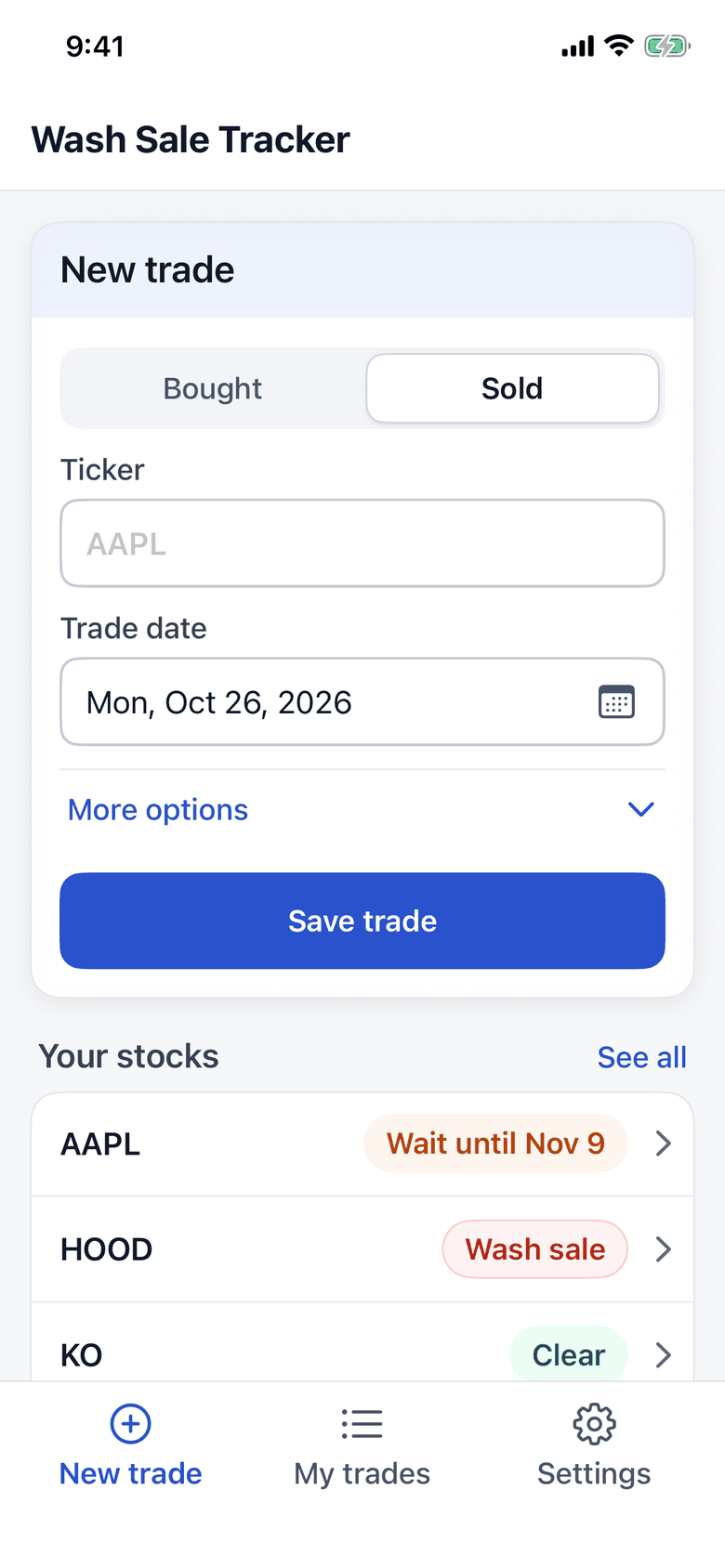
Free wash sale calculator. Tell us your trade and we'll show the first day you can trade it without losing your tax loss.
Type a ticker and a date. That’s it.
The short answer
You can buy the same stock again on the 31st calendar day after the sale. A buy on day 30 still counts, and so do buys in the 30 days before the sale.
Count calendar days from the trade date, not the day the money settled. Weekends and market holidays don't stretch the wait. They only matter when day 31 lands on a day the market is closed. Then your first chance to buy is the next trading day.
| Loss sale | Last day a buy counts | You can buy again |
|---|---|---|
| Thu, Oct 22, 2026 | Last day a buy counts: Sat, Nov 21 | Mon, Nov 23, 2026Day 31 is a Sunday |
| Tue, Nov 10, 2026 | Last day a buy counts: Thu, Dec 10 | Fri, Dec 11, 2026Day 31 is a trading day |
| Wed, Nov 25, 2026 | Last day a buy counts: Fri, Dec 25 | Mon, Dec 28, 2026Day 31 is a Saturday |
| Tue, Dec 1, 2026 | Last day a buy counts: Thu, Dec 31 | Mon, Jan 4, 2027Jan 1 is New Year's Day, then a weekend |
| Tue, Dec 15, 2026 | Last day a buy counts: Thu, Jan 14 | Fri, Jan 15, 2027Day 31 is a trading dayCrosses tax years |
| Fri, Dec 18, 2026 | Last day a buy counts: Sun, Jan 17 | Tue, Jan 19, 2027Jan 18 is Martin Luther King Jr. DayCrosses tax years |
How the rule works
A loss is washed if you buy the same or a substantially identical stock 30 days before or after the sale. With the sale day itself, that's a 61-day window.
Weekends and holidays count toward the 30 days. They only matter because you can't trade on them. Enter a trade in the calculator above to see your own window on a bar.
The math
A washed loss isn't deductible now. It's added to the cost of the new shares, so in most cases it's delayed, not lost.
The new shares also keep the holding period of the shares you sold (IRC §1223(3)). You claim the loss when you finally sell the new shares outside a wash window. If you buy back fewer shares than you sold, only that many shares' loss is washed, matched in the order you bought them.
You buy 100 shares for $1,000, sell them for $750, and buy 100 again within 30 days for $800.
The 250 dollar loss is washed and added to the 800 dollar repurchase cost, for a new cost basis of 1,050 dollars.
New cost basis$1,050
100 shares sold at a $1,000 loss, then four different next moves.
Waiting 31 days or more keeps all 1,000 dollars deductible. Buying 25 of the 100 shares back inside the window leaves 750 dollars deductible and moves 250 dollars into the new shares. Buying all 100 back in a taxable account moves the full 1,000 dollars into the new shares. An IRA or Roth IRA buy loses the 1,000 dollars for good.
The triggers
IRS Publication 550 lists four ways to get a replacement inside the window. Any one of them washes the loss.
Source: IRS Publication 550, Wash Sales; 26 U.S.C. §1091(a).
Count calendar days. Use the trade date on your confirmation, never the settlement date.
26 U.S.C. §1091 · Pub 550
If your spouse or a company you control buys the same stock, it counts as your buy.
IRS Publication 550
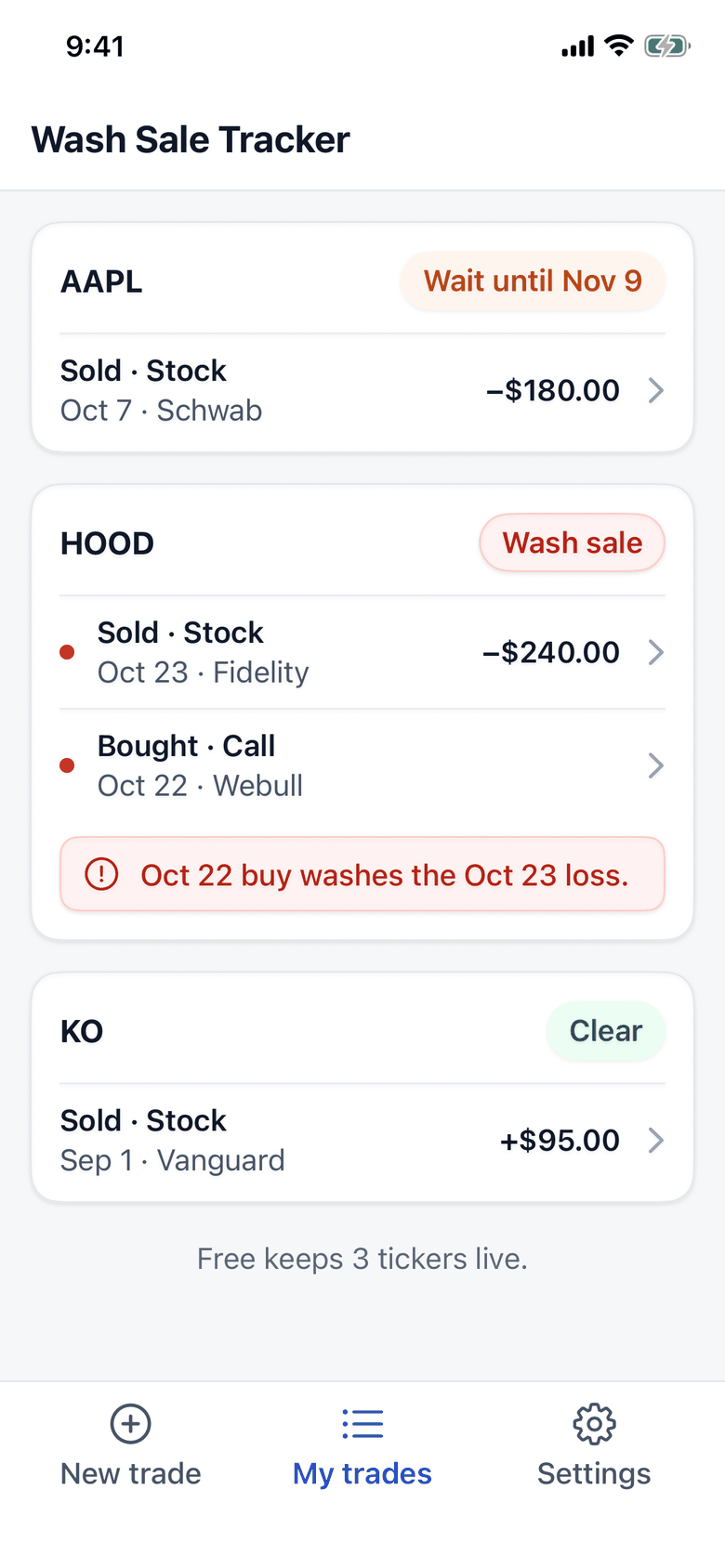
Buying a call on the stock washes a stock loss. Selling a deep-in-the-money put can too, and option losses are covered.
§1091 · Rev. Rul. 85-87
A stock bonus of the same stock received within 30 days of a loss sale washes the loss.
Pub 550, Example 2
Brokers only flag a wash when the sale and the buy are in the same account. The rest is still yours to adjust.
Form 1099-B instructions
The rule doesn't apply to losses on commodity futures contracts or foreign currencies.
IRS Publication 550
The costly traps
An IRA or Roth IRA buy inside the window is the worst case: the loss is gone for good. A dividend reinvestment is smaller: it washes only the reinvested shares.
IRA or Roth IRA buy
Under Rev. Rul. 2008-5, if your IRA or Roth IRA buys the stock inside the window, the loss is washed and the IRA's cost isn't raised. Nothing carries forward.
$0 deductible$2,000 lost for good
Example: a $2,000 loss sale on Tue, Dec 1, 2026, then a Roth IRA buy on Mon, Dec 14.
Dividend reinvestment
A $1,000 loss on 200 shares, then 6 shares reinvested inside the window: only those 6 shares' part of the loss is washed, and it moves into their cost.
$970 deductible$30 into new shares
Rev. Rul. 2008-5 covers your own IRA or Roth IRA. The IRS hasn't ruled on a spouse's IRA or a 401(k), so treating them the same way is the safe reading. Turn off auto-reinvest on a ticker, in every account, before you sell it at a loss.
Gray zones
The IRS judges it case by case and has never drawn an exact line. The same stock always counts. Another company's stock usually doesn't.
| Replacement | Substantially identical? |
|---|---|
| The same stock or fund | Yes |
| A call option on the same stockAn option to acquire it | Yes |
| Warrants for the common stock you soldIRS Publication 550, Warrants | Yes |
| A different fund on the same indexThe IRS has never ruled on it | Maybe |
| Convertible preferred of the same companyJudged on conversion terms, voting and dividend rights | Maybe |
| A fund on a different indexCommon practice, not an IRS safe harbor | Usually no |
| Another company's stockEven in the same sector | Usually no |
| Bonds or regular preferred of the same company | Usually no |
Reporting
Report the sale on Form 8949 as usual. Enter code W in column (f) and the washed loss as a positive number in column (g).
Example: 80 shares of XYZ that cost $4,960 sold for $3,720, and a buy inside the window washed the whole loss.
Maya sold Tesla at a $5,000 loss on Dec 15 to lower her tax bill.
On Jan 5 the price looked good, so she bought it back. That was day 21, inside the 30-day window.
Her $5,000 loss didn't count that year. It got pushed into her new shares instead. If she'd bought it back in her IRA, the loss would be gone for good.
Check your date first. It takes 5 seconds.FAQ
Accurate as of October 26, 2026.
If you sell a stock at a loss and buy the same or a substantially identical stock within 30 days before or after the sale, you can't deduct the loss then. It moves into the cost of the new shares instead. With the sale day itself, that's a 61-day window.
Wait until the 31st calendar day after the sale. A repurchase on day 30 still triggers the rule. Weekends and holidays count as days. They matter only because you cannot trade on them, so if day 31 is a Saturday, Sunday, or market holiday, your first practical buy day is the next trading day. Example: a loss sale on Thu Oct 22, 2026 can be safely repurchased starting Mon Nov 23, 2026.
If you bought shares of the same stock in the 30 days before your loss sale, the loss can already be washed (unless the shares you sold are those same new shares). If you already sold the newly bought shares before the loss sale, check with a tax professional.
Yes. Buying a call option on the same stock within 30 days before or after a loss sale counts as buying the stock, so it washes the loss. Losses on options can be washed too. The IRS hasn't said whether an option with a different strike or expiration date is substantially identical.
Usually not. The disallowed loss is added to the cost basis of the replacement shares, and your old holding period carries over to them. You claim the loss when you finally sell the replacement shares outside a wash window. The big exception is a repurchase inside an IRA or Roth IRA (see the next question).
Yes, and it is the worst case. Under IRS Revenue Ruling 2008-5, a loss sale in a taxable account followed by your IRA or Roth IRA buying the same stock within 30 days disallows the loss, and the IRA's basis is not increased. The loss is permanently gone, not deferred. Treat a spouse's IRA, and probably a 401(k), the same way to be safe. The IRS has not ruled on those specifically.
Yes. An automatic dividend reinvestment is a purchase, so a DRIP buy inside the window washes the loss on that many shares. Stock received as compensation counts too. IRS Pub 550's example is a stock bonus received within 30 days of a loss sale. Turn off auto-reinvest on that ticker in every account before you harvest the loss.
As of October 26, 2026, no. Ordinary cryptocurrency is not "stock or securities" under current law, and no enacted law has changed that. However, H.R. 10357 (the Digital Asset Tax Certainty Act) passed the House Ways and Means Committee on Sep 16, 2026. If enacted as written, it would apply the rule to traded digital assets (not qualifying U.S. dollar stablecoins) disposed of after Sep 14, 2026. The bill has not passed the full House or Senate. A token that legally is the stock or security (or an option or contract to acquire it) is covered under current law; tokens that only track a stock's price are not clearly covered yet.
Sources
WashSaleCalc follows IRS Publication 550 (2025 edition), 26 U.S.C. §1091 and Treas. Reg. §1.1091‑1. The window is counted in calendar days from your trade date. When day 31 falls on a weekend or market holiday, the first trading day uses NYSE's published holiday calendar where available (currently through 2028) and NYSE's standard holiday rules for later years through 2040; unscheduled closures can only push the trading day later. Replacement buys are matched to sold shares in the order you bought them.